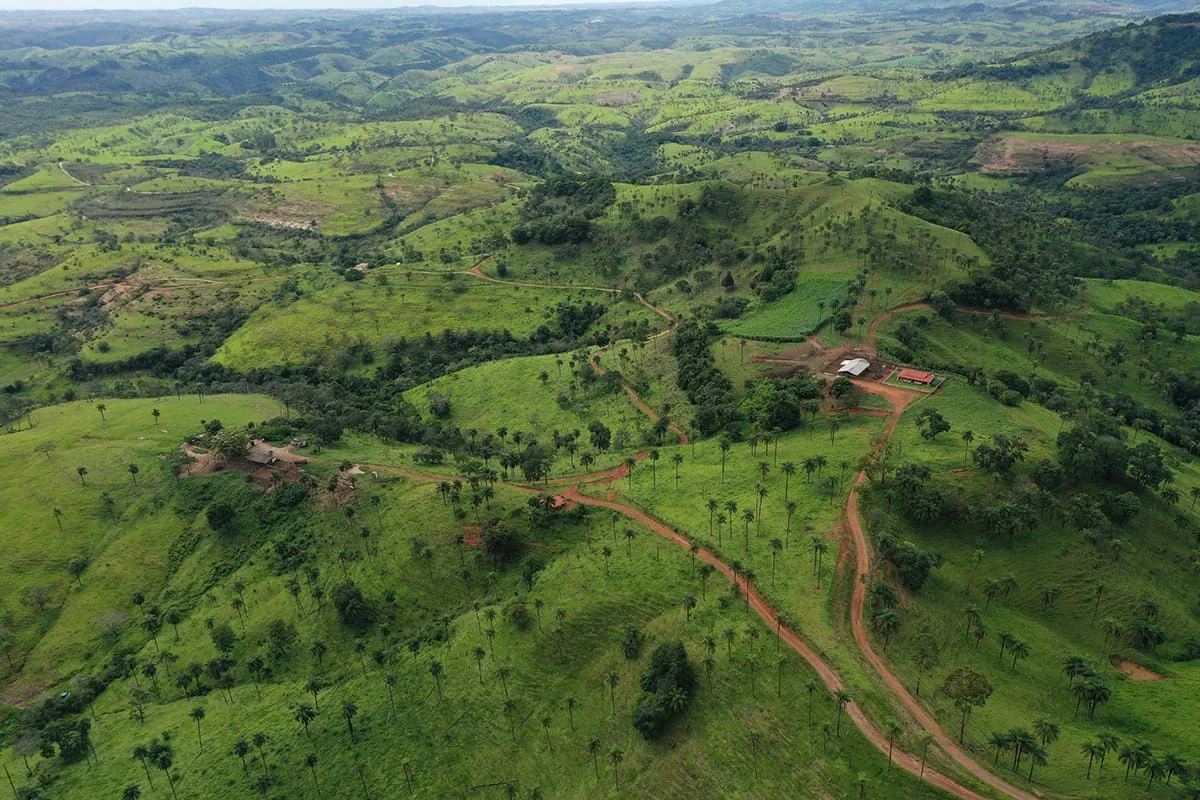
Man of War is OBY’s rare earth exploration and development project in São Gotardo and Matutina, Minas Gerais, Brazil.
Current stageExploration and technical development
The project combines an inferred mineral resource with geological investigation and preliminary metallurgical testwork. Further technical and economic work is required before development decisions can be made.
The proposed industrial plan comprises a planned commercial plant and a planned expansion. Both remain subject to validation, authorisations, access, financing and investment decisions.
02 / Setting
Location and infrastructure
In the municipalities of São Gotardo and Matutina, in the Brazilian state of Minas Gerais.
The region is connected by the BR-262, BR-354 and MG-235 road network. Local access includes unpaved roads.
Nearby roads, power and water are regional context. Their proximity does not establish secured project access, available capacity, connection agreements or the permissions required to use them.
Location and infrastructure context: SGS/BNA technical report, effective 14 July 2026.
Man of War project landscape, Minas Gerais, Brazil.
03 / Technical basis
Geology and mineral resources
The resource model covers regolith and saprolite at Nau de Guerra, Alto da Serra and Balsamo. Fragata and Caravela are additional exploration targets; they are not included in the resource figures below.
1.35 billion tonnesInferred mineral resource
3,437 ppm TREOGrade at a 1,000 ppm TREO cut-off
TREO means total rare earth oxides, including yttrium oxide in this estimate. ppm means parts per million.
Inferred mineral resources are not mineral reserves and do not have demonstrated economic viability. Further work may not upgrade their confidence, and there is no certainty that a mining operation will be realised.
Resource estimate effective 18 December 2024. Technical report effective 14 July 2026, dated 31 July 2026. Source: SGS Canada Inc. / SGS Geological Services and BNA Mining Solutions, Technical Report on the Mineral Resource Estimate for the Man of War Project, Minas Gerais, Brazil; Tables 14-22 and 14-23.
Higher cut-off scenario and estimation basis
At a cut-off of 4,000 ppm TREO, the estimate reports 372 million tonnes at 5,130 ppm TREO, also classified as inferred. This scenario overlaps the 1.35 billion tonne estimate. The two cases must not be added together.
The estimate is reported on a 100% project basis, in dry tonnes, within conceptual open-pit shells used to assess reasonable prospects for eventual economic extraction. Tonnages and grades are rounded. This resource basis does not define the material basis of the planned plant capacities.
Geological continuity does not establish metallurgical continuity. Conceptual resource assumptions do not constitute an approved mine plan or an economic production case.
04 / Process evaluation
Metallurgical testwork
Preliminary laboratory screening supports further evaluation of potential processing routes.
Historical SGS desorption testwork examined selected samples and prepared material. Response varied across the samples; laboratory extraction results do not establish commercial recovery or performance across the deposit.
Further work is needed on representative geological domains, material preparation, reagent consumption, impurities, solid–liquid separation, downstream losses and repeatability.
Potential products, including mixed rare earth carbonate, remain under technical evaluation. Product specifications, commercial suitability and customer qualification have not been established by this work.
Selected laboratory result: basis and limitations
Five adjacent one-metre samples from the selected AP-ND-05 interval at 9–14 metres returned 519 grams per tonne (g/t) of extracted rare earth oxide equivalents, excluding lanthanum and cerium, per tonne of prepared laboratory fraction.
The historical SGS ICM694 screening used material passing 1 mm, 40 g aliquots, 0.5 mol/L (moles per litre) ammonium sulfate at nominal pH 4 for 30 minutes at ambient temperature, without continuous pH control or overhead agitation.
This selected interval is not representative of whole-deposit recovery, whole-feed yield, product purity or saleable output. The result cannot be divided by the mineral resource grade to calculate a commercial recovery.
Source: SGS ICM694 historical screening, as summarised in OBY’s technical presentation dated 28 October 2026. Further controlled and representative testwork is required.
05 / Development roadmap
Two-phase development roadmap
Two planned industrial phases, with milestones linked to evidence and implementation decisions.
Development is subject to technical and economic studies, engineering, applicable authorisations and access, financing and investment decisions. Milestones may progress in parallel where appropriate; implementation dates have not been set for this plan.
Planned
Phase 1 — Commercial Plant
Planned capacity:25–100 tonnes per hour
Develop a commercial plant within the planned capacity range, subject to the applicable studies, engineering, authorisations and financing.
Studies and scope definition
Planned
Define the commercial plant scope within the planned capacity range.
Depends on Resource information, representative testwork and the development basis.
Engineering and process validation
Planned
Validate the process route and develop the plant engineering.
Depends on Representative samples, repeatable testwork and agreed design criteria.
Authorisations and access
Planned
Obtain the permissions and access required for implementation.
Depends on Environmental studies, water requirements, surface access and regulatory review.
Financing and investment decision
Planned
Establish the funding plan and assess the investment decision.
Depends on Technical and economic assessment, project scope, approvals and financing availability.
Construction and implementation
Planned
Construct and install the planned commercial plant.
Depends on Investment approval, funding, required authorisations, engineering and procurement.
Commissioning
Planned
Test systems and validate integrated plant performance.
Depends on Installation readiness, safe operating procedures and commissioning acceptance criteria.
Operation and planned capacity
Planned
Establish operation within the validated design and planned capacity range.
Depends on Commissioning outcomes, operating authorisations and demonstrated process performance.
Planned
Phase 2 — Expansion
Planned capacity:5 million tonnes per year
Develop the expansion towards the planned scale of 5 million tonnes per year, subject to technical and economic validation and the other conditions required for implementation.
Studies and scope definition
Planned
Define the expansion scope and assess the planned scale.
Depends on Updated resource information, technical studies and the expansion basis.
Engineering and process validation
Planned
Validate the expansion design and process at the intended scale.
Depends on Representative testwork, scale-up assessment and relevant operating information as available.
Authorisations and access
Planned
Secure the permissions and access required for the expansion.
Depends on Expansion impact assessment, water and infrastructure requirements and regulatory review.
Financing and investment decision
Planned
Assess expansion economics and secure the investment basis.
Depends on Technical and economic validation, required approvals and financing availability.
Construction and implementation
Planned
Build and integrate the expansion facilities.
Depends on Investment approval, funding, authorisations, detailed engineering and procurement.
Commissioning
Planned
Test and commission the integrated expansion.
Depends on Construction readiness, systems integration and agreed performance criteria.
Operation and planned capacity
Planned
Progress towards the planned annual capacity as performance is validated.
Depends on Commissioning outcomes, operating authorisations and demonstrated sustainable performance.
The capacities are planning targets, not quantities of rare earth oxides or saleable product. The two capacities are not added together.
06 / Responsible development
Environmental and community work
Environmental assessment, local engagement and access planning form part of the proposed development work.
Planned
Environmental studies and authorisations
Define baseline and impact studies, water requirements and the permissions applicable to each phase. Study work does not itself authorise construction or operation.
Planned
Community engagement and surface access
Plan engagement with local stakeholders and address surface access requirements as the project scope develops. Mineral rights, surface access and environmental permissions are separate requirements.